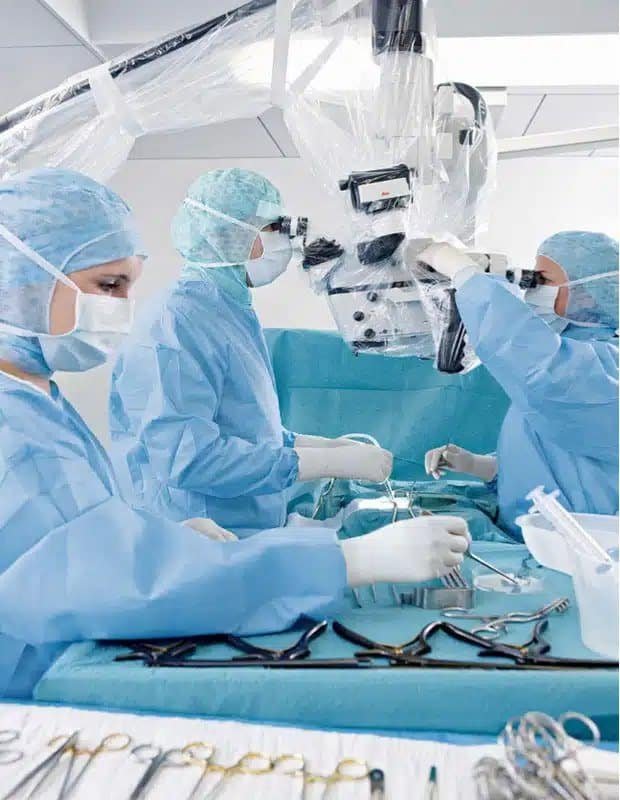
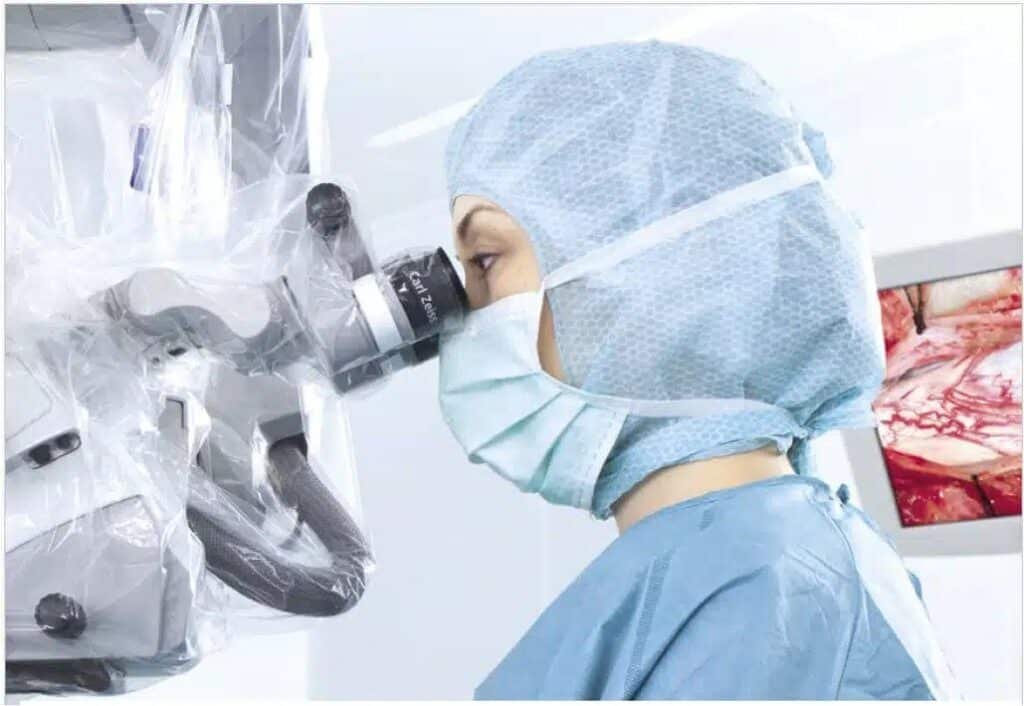
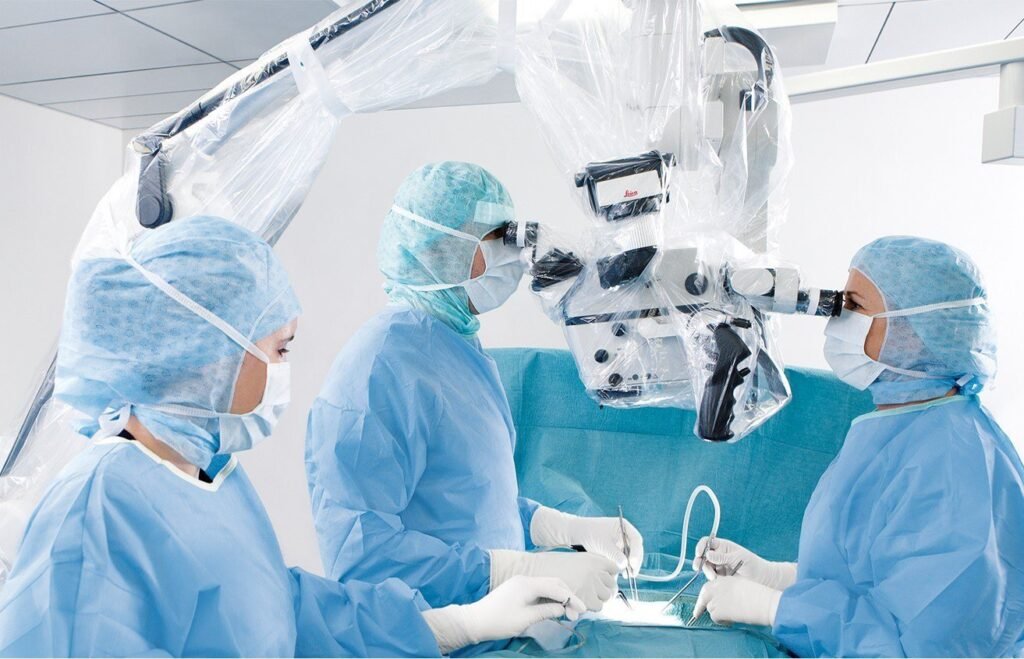
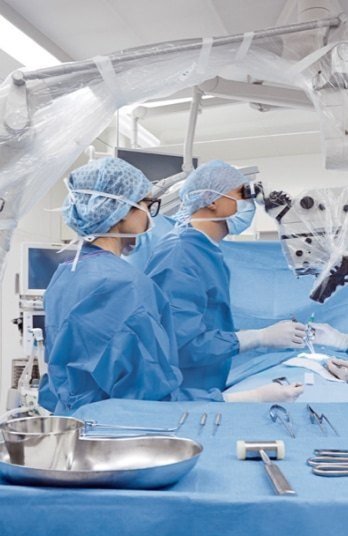
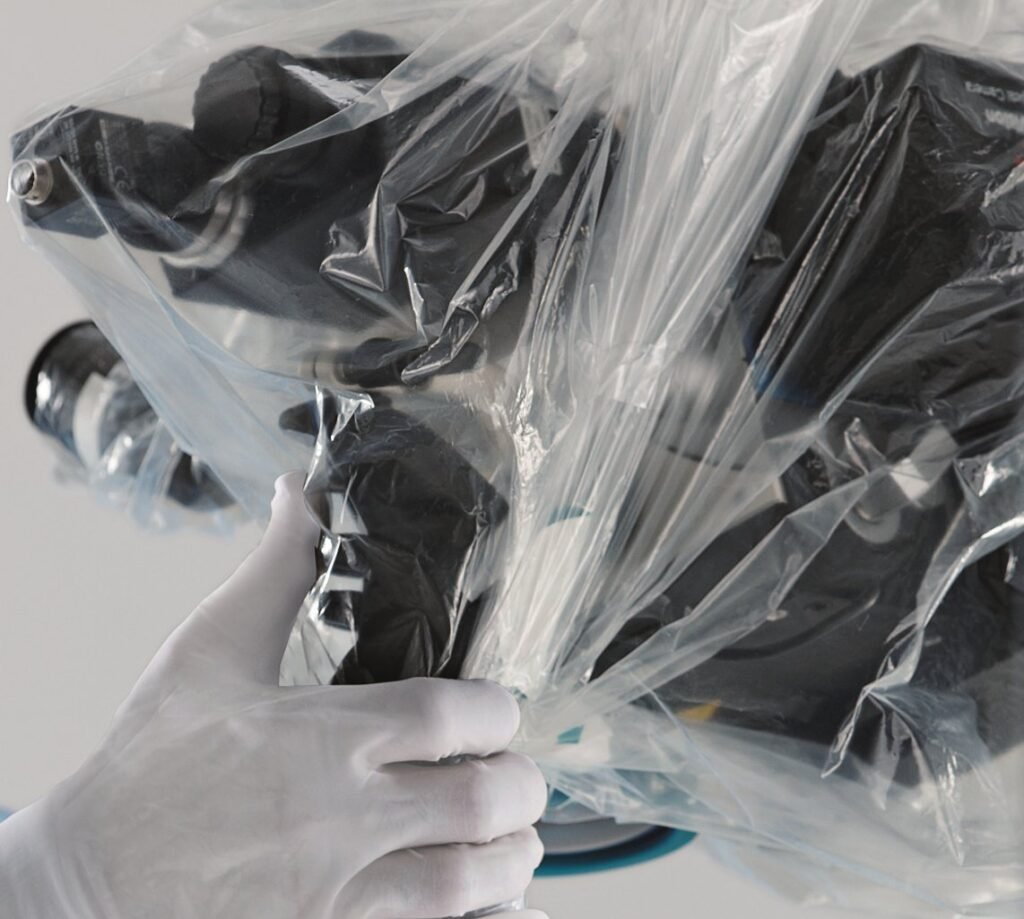
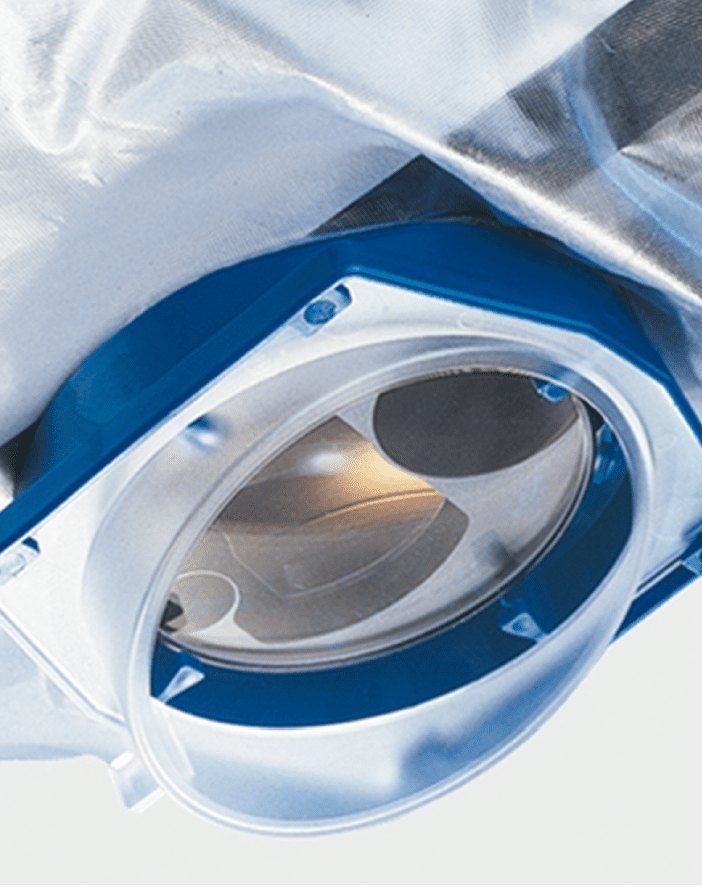
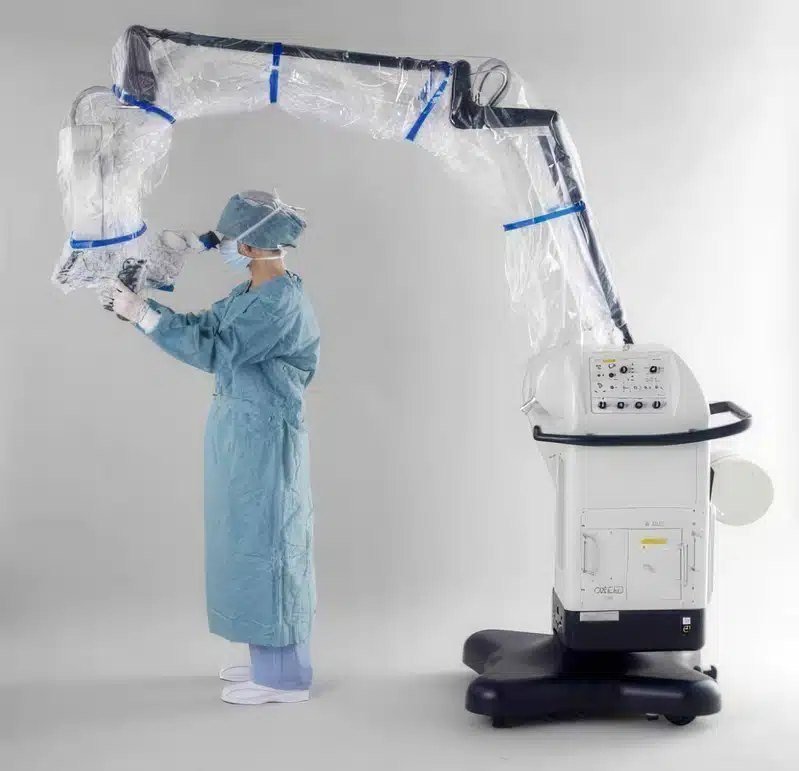
Leica microscopes are some of the most common in US operating rooms. Each model has a different head, a different number of eyepieces and a different arm. That means each one needs the right drape and a slightly different draping routine.
This guide covers three popular Leica models and the drape that fits each one.
Key takeaways
The M525 OH4 takes a 150 inch drape with four ocular covers (ASP54-150).
The M525 F20, F40, F50 and PROvido take a 120 inch drape with three ocular covers (ASP54-120).
Check with ASP before ordering drapes for an M320.
Always seat the lens ring first and re-balance the microscope after draping.
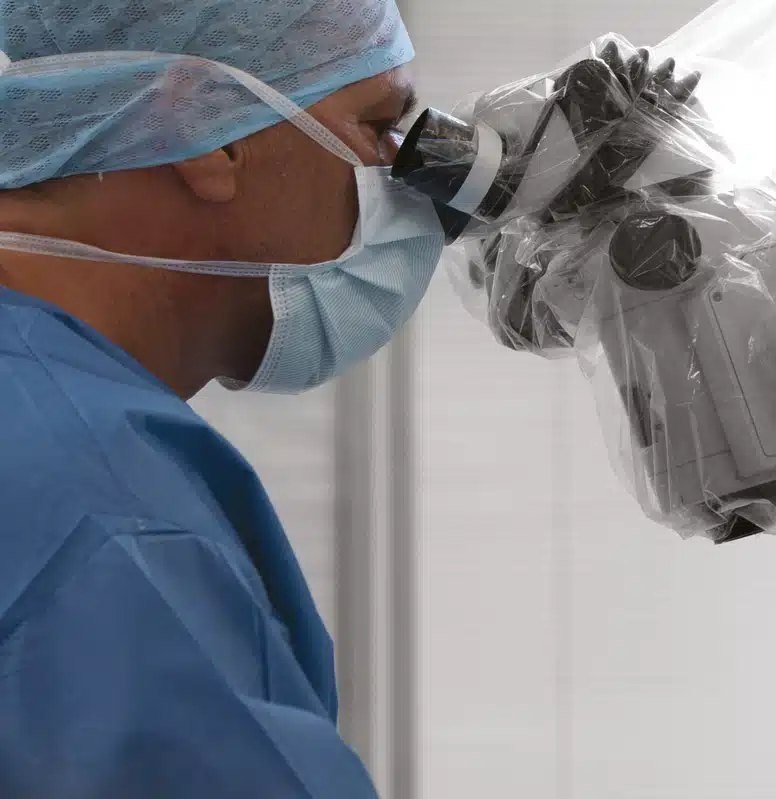
A surgeon working through a draped Leica microscope
Before You Start: The Basics for Any Leica Model
The core steps are the same on every Leica microscope. Our step-by-step draping guide covers them in full. In short:
Lock the stand and position the optics head at working height.
Open the pack without touching the sterile side.
Seat the lens ring on the objective lens first.
Fit the ocular covers over each set of eyepieces.
Unroll the drape back along the arm and secure it with the ties.
Re-balance the microscope, then check the full range of motion.
Both ClearLens drapes are 54 inches wide, have a non-glare glass lens and come sterile, 10 per case.
Draping the Leica M525 (OH4 and F Series)
The M525 comes in two main versions, and they take different drapes.
M525 OH4 (Floor Stand With Large Arm)
Drape: Leica ClearLens, ASP54-150 (150 inches, four ocular covers)
Why the longer drape: The OH4 stand has a long reach, so the drape needs to cover more arm.
Tip: Cover the main surgeon’s eyepieces first, then the assistant’s, then any side observer tubes.
M525 F20, F40 and F50
Drape: Leica ClearLens Lite, ASP54-120 (120 inches, three ocular covers)
Tip: These stands are more compact. A shorter drape gives less loose material to gather around the joints.
Quick tip: Re-balance the M525 after draping. The drape adds a small amount of weight to the optics carrier, and an unbalanced head can drift during the case.
Draping the Leica PROvido
The PROvido is a compact microscope often used in spine, ENT and plastic surgery.
Drape: Leica ClearLens Lite, ASP54-120
Step 1: Seat the glass lens over the objective and check it sits flat.
Step 2: Fit the three ocular covers. Leave slack so the eyepieces can still tilt.
Step 3: Unroll along the arm and gather the excess with the built-in ties.
Step 4: Check that the handgrips and their buttons are easy to use through the drape.
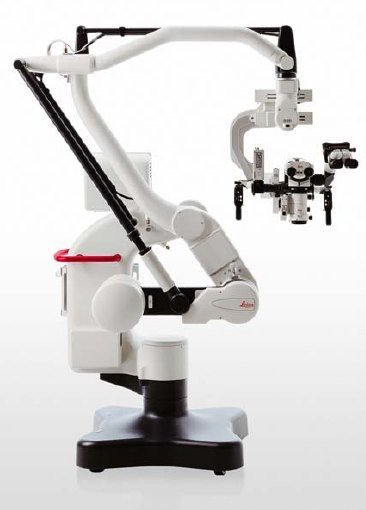
A Leica M520 OH3 surgical microscope, which takes the 150 inch ClearLens drape
Draping the Leica M320
The M320 is a smaller microscope, common in ENT and dental work. It is often set up on a floor stand, wall mount or ceiling mount.
Because the setups vary so much, the right drape depends on how your M320 is mounted. Call ASP at 1 (866) 573-7774 and we will confirm the right option for your setup before you order.
The Leica M320 F12, available to rent monthly through DB Surgical
Light from the microscope shines down through the drape’s lens window. With a poor lens, some of that light bounces back and causes glare. Surgeons then wipe or remove the lens cover mid-case, which risks the sterile field.
ASP’s ClearLens drapes use a non-glare glass lens to keep the view clear from the first cut to closing.
Frequently Asked Questions
Which drape fits the Leica M525?
The M525 OH4 takes the 150 inch ClearLens (ASP54-150). The M525 F20, F40 and F50 take the 120 inch ClearLens Lite (ASP54-120).
Which drape fits the Leica PROvido?
The Leica ClearLens Lite (ASP54-120), with three ocular covers.
Are ASP drapes made by Leica?
No. They are compatible sterile drapes designed to fit the Leica models listed. They cost less than buying through a manufacturer’s sales rep.
American Surgical Products has supplied hospitals and surgery centers across the United States since 2010, with no sales reps and no markups. It is the online store of DB Surgical, a Florida medical device distributor founded in 1997 whose Leica-certified technicians service surgical microscopes across the Southeast. Questions? Call 1 (866) 573-7774 or email service@americansurgicalproducts.com. Se habla español.
This article is general information for clinical and purchasing teams. It is not medical advice. Always follow the manufacturer’s instructions for use and your facility’s policies.
Ordering the wrong microscope drape wastes a case and can delay surgery. This page is a quick lookup: find your microscope, see the drape that fits, and order.
Bookmark it and share it with your OR buyer.
Key takeaways
Find your microscope model in the chart below to get the matching ASP item number.
Every ASP microscope drape is sterile, individually packaged and sold 10 per case.
Zeiss drapes from ASP do not activate the RFID function on Zeiss microscopes.
Not sure? Call 1 (866) 573-7774 or request a free trial before you buy.
A Zeiss microscope covered with an ASP LensGuard drape
LensGuard vs LensGuard Lite: Which Zeiss Drape?
Both fit the same Zeiss models and are the same size. The difference is the lens.
Feature
Zeiss LensGuard (ASP27-Z)
Zeiss LensGuard Lite (ASP26-Z)
Rapid lens replacement
Yes
No
Ocular covers
3
3
Size
54 x 150 in
54 x 150 in
Best for
Long or messy cases where the lens may need swapping
Routine cases at a lower cost
Rapid lens replacement means your team can swap a soiled lens mid-case without replacing the whole drape.
ClearLens vs ClearLens Lite: Which Leica Drape?
The choice depends on your microscope, not preference.
ClearLens (ASP54-150): Longer drape and four ocular covers for large floor-stand microscopes like the ARveo, M530 and M525 OH4.
ClearLens Lite (ASP54-120): Shorter drape and three ocular covers for compact models like the PROvido and M525 F series.
Both use a non-glare glass lens.
A Mitaka microscope draped with ClearGuard in the operating room
What to Check Before You Order
Your exact model name. It is usually printed on the stand or the optics carrier.
Any add-ons. Extra observer tubes or cameras can change which drape works best.
How many cases you run. Each case of drapes holds 10.
Your PO or payment method. ASP accepts credit card or a valid purchase order.
Quick tip: Running more than one brand of microscope? Keep a printed copy of this chart in your sterile core so nobody grabs the wrong drape.
Frequently Asked Questions
My microscope is not on this chart. What should I do?
Call ASP at 1 (866) 573-7774 or contact us online. We will tell you if we have a drape that fits.
Will an ASP Zeiss drape trigger the microscope’s RFID?
No. ASP item numbers ASP26-Z and ASP27-Z do not activate any RFID function on Zeiss microscopes. Check with your team if your workflow depends on that feature.
How many drapes come in a case?
Every ASP microscope drape case holds 10 sterile, individually packaged drapes.
American Surgical Products has supplied hospitals and surgery centers across the United States since 2010, with no sales reps and no markups. It is the online store of DB Surgical, a Florida medical device distributor founded in 1997 whose Leica-certified technicians service surgical microscopes across the Southeast. Questions? Call 1 (866) 573-7774 or email service@americansurgicalproducts.com. Se habla español.
Operating rooms use two kinds of sterile drapes: single-use (disposable) drapes and reusable cloth drapes that are washed and sterilized between cases. Both are common, and both have loyal fans.
So which one prevents more infections? This article sums up what the World Health Organization (WHO) found and what else matters when you choose.
Key takeaways
WHO found no clear difference in surgical site infection rates between disposable and reusable drapes.
WHO says either sterile disposable or sterile reusable drapes can be used.
The evidence is limited, so cost, workflow and barrier quality should drive the choice.
For surgical microscopes, disposable drapes are the practical standard.
The Short Answer
WHO’s global guidelines on preventing surgical site infection (SSI) looked at this exact question. The panel suggests that either sterile disposable non-woven drapes or sterile reusable woven drapes can be used.
In other words, there is no strong evidence that one type is safer than the other for preventing infection.
What the WHO Review Actually Looked At
The WHO team reviewed 11 studies comparing disposable and reusable drapes and gowns. These included randomized trials and observational studies across several surgical specialties.
Their main findings:
When they combined the best-quality studies, disposable drapes and gowns showed neither benefit nor harm compared with reusable ones.
The studies used many different materials, which makes direct comparison hard.
The overall certainty of the evidence was rated very low.
This is why WHO made a conditional recommendation rather than telling hospitals to pick one type.
Question
What WHO found
Do disposable drapes reduce SSI?
No clear difference vs reusable
Is the evidence strong?
No, certainty rated very low
What does WHO recommend?
Either sterile disposable or sterile reusable drapes
Do plastic adhesive incise drapes reduce SSI?
No evidence that they do
If Infection Rates Are Similar, What Should Decide?
When the safety evidence is a tie, practical factors matter more.
Barrier Performance
A drape must stop fluids and microbes reaching the sterile field. Reusable fabric can lose barrier quality after many wash cycles. Disposable drapes are new every time. In the US, many facilities check barrier claims against the AAMI PB70 levels for liquid barrier performance.
Cost
Disposable: You pay per drape, plus waste disposal.
Reusable: You pay for the drapes, laundering, inspection, repair, sterilization and tracking.
The cheaper option depends on your volume and whether you run your own laundry.
Workflow
Disposable drapes arrive sterile and ready to open. Reusable drapes depend on your laundry and sterile processing teams keeping up with your case load.
Environmental Impact
Disposable drapes create more waste. Reusable drapes use more water, energy and detergent. The net impact depends on local conditions.
A disposable microscope drape in use during surgery
Why Microscope Drapes Are Almost Always Disposable
The WHO question was about patient drapes and gowns. Equipment drapes are a different case.
A surgical microscope needs a clear, fitted cover with a lens window and eyepiece covers. Cloth cannot do that job. That is why microscope drapes are single-use, clear plastic products made for each model.
When you choose a disposable microscope drape, check:
American Surgical Products has supplied hospitals and surgery centers across the United States since 2010, with no sales reps and no markups. It is the online store of DB Surgical, a Florida medical device distributor founded in 1997 whose Leica-certified technicians service surgical microscopes across the Southeast. Questions? Call 1 (866) 573-7774 or email service@americansurgicalproducts.com. Se habla español.
This article is general information for clinical and purchasing teams. It is not medical advice. Always follow the manufacturer’s instructions for use and your facility’s policies.
Microscope drapes are a repeat cost. Every case needs a new one. So it is natural for OR managers to ask: do we have to buy the manufacturer’s own (OEM) drape, or is a lower-cost compatible drape just as safe?
Here is a straight answer, plus a checklist for switching.
Key takeaways
Compatible (non-OEM) drapes are legal medical devices regulated by the FDA, just like OEM drapes.
Safety comes down to sterility, barrier quality and fit, not the brand on the box.
Ask any supplier for compatibility lists, sterility details and a trial before you switch.
Lower prices usually come from a simpler supply chain, not lower standards.
What “OEM” and “Generic” Mean
OEM drape: Sold by or for the microscope’s manufacturer.
Generic or compatible drape: Made by another company to fit the same microscope models.
Both are sterile, single-use products. Both cover the same microscope. The difference is who makes and sells them.
How Microscope Drapes Are Regulated
In the US, surgical drapes fall under FDA regulation 21 CFR 878.4370, “Surgical drape and drape accessories.” They are Class II medical devices.
That rule applies no matter who makes the drape. A compatible drape is not a lesser category of product. Many drape types are exempt from FDA’s 510(k) premarket notification, but makers must still meet FDA’s quality system and labeling rules.
So, Are Lower-Cost Drapes Safe?
A drape is safe when it does three things well:
Stays sterile until it is opened in the OR.
Blocks fluids and microbes from reaching the sterile field.
Fits the microscope without tearing, pulling or blocking the view.
A well-made compatible drape can do all three. A poorly made drape can fail, whatever the brand. That is why you should judge the product, not the label.
A compatible Zeiss microscope drape in use in the OR
Checklist: What to Ask Before You Switch
Question to ask
Why it matters
Which exact microscope models does it fit?
Poor fit causes tears and glare
Is it sterile and individually packaged?
Protects the sterile field
What lens does it use?
Glass or non-glare lenses reduce glare
How many ocular covers does it have?
Must match your scope’s eyepieces
Does it affect RFID or other scope features?
Some microscopes read drape tags
Can we trial it first?
Lets your surgeons judge the fit
Is supply reliable?
A stock-out can cancel cases
Quick tip: Ask your lead surgeon and two or three scrub techs to try a sample drape before you switch the whole department. Their buy-in matters as much as the price.
Where the Savings Come From
Lower prices on compatible drapes usually come from how they are sold, not how they are made:
No sales reps. Rep commissions are built into many medical supply prices.
Fewer middle layers. Buying direct online removes distributor markups.
Focused range. A supplier that stocks a few drapes well can keep costs down.
At the time of writing, ASP lists its drapes at:
Drape
Price per case of 10
Price per drape
Leica ClearLens (ASP54-150)
$398
$39.80
Leica ClearLens Lite (ASP54-120)
$398
$39.80
Zeiss LensGuard (ASP27-Z)
$398
$39.80
Zeiss LensGuard Lite (ASP26-Z)
$298
$29.80
ClearGuard for Mitaka MM51 or MM90
$299
$29.90
Compare these with your current invoice to see your cost per case.
A Note on Zeiss RFID
Some Zeiss microscopes can read RFID tags on OEM drapes. ASP’s Zeiss drapes (ASP26-Z and ASP27-Z) do not activate any RFID function. If your team relies on that feature, talk to us before switching.
Frequently Asked Questions
Are generic microscope drapes FDA regulated?
Yes. All surgical drapes sold in the US are regulated under 21 CFR 878.4370, whoever makes them.
Will a non-OEM drape void my microscope warranty?
A drape is a separate disposable product. Check your service contract for any specific terms, and ask DB Surgical’s service team if you are unsure.
Why are compatible drapes cheaper?
Mostly because they are sold without sales reps and extra distribution layers.
How do I know a drape will fit?
Check the compatibility list, then run a free trial on your own microscope.
American Surgical Products has supplied hospitals and surgery centers across the United States since 2010, with no sales reps and no markups. It is the online store of DB Surgical, a Florida medical device distributor founded in 1997 whose Leica-certified technicians service surgical microscopes across the Southeast. Questions? Call 1 (866) 573-7774 or email service@americansurgicalproducts.com. Se habla español.
This article is general information for clinical and purchasing teams. It is not medical advice. Always follow the manufacturer’s instructions for use and your facility’s policies.
There is no single official count. Surgical microscopes are usually grouped in two ways: by specialty (what surgery they are built for) and by mount (how they are held over the patient).
This guide explains both, so you can understand what your OR has and what it needs.
Key takeaways
By specialty, the main types are neurosurgery and spine, ENT, ophthalmic, dental, and plastic and reconstructive.
By mount, they are floor stand, ceiling, wall and tabletop.
Each type has different optics, reach and features.
Each model needs a drape made for its shape.
A surgical team operating under a microscope
Types of Surgical Microscopes by Specialty
1. Neurosurgery and Spine Microscopes
These are the largest and most advanced. They need long reach, deep focus and strong light for work in narrow, deep spaces.
Common features: Long working distance, motorized zoom and focus, fluorescence modes, built-in cameras, and side eyepieces for an assistant
Examples: Leica ARveo and M530, Zeiss Kinevo and Pentero
Drape: A long drape with three or four ocular covers
2. ENT (Ear, Nose and Throat) Microscopes
ENT surgeons need a fine view of small structures, like the middle ear.
Common features: Compact head, shorter working distance, good maneuverability
Examples: Leica M320 and M525 F series
Drape: Usually a shorter drape
3. Ophthalmic (Eye) Microscopes
Built for cataract, retina and corneal surgery.
Common features: Foot pedal control of focus and zoom, special lighting that creates a red reflex in the eye, and coaxial light
Drape: Specialist ophthalmic drapes
4. Dental Microscopes
Used for root canals and other fine dental work.
Common features: Small, light, often mounted on the wall or ceiling of the treatment room
5. Plastic and Reconstructive Microscopes
Used for joining tiny blood vessels and nerves (microsurgery).
Common features: High magnification, very steady positioning, and two-surgeon viewing
The Leica M720 OH5, a large floor-stand microscope used in neurosurgery
Types of Surgical Microscopes by Mount
Mount type
How it works
Best for
Floor stand
Wheeled base, can move between rooms
Hospitals that share scopes between ORs
Ceiling mount
Fixed to the ceiling, frees floor space
Dedicated neuro or spine rooms
Wall mount
Arm fixed to the wall
Dental and small procedure rooms
Tabletop
Sits on a table or cart
Labs and small clinics
Floor stands are the most common in US operating rooms because one microscope can serve several rooms.
Which Type Does Your OR Need?
Ask these questions:
What procedures will you run? Spine and neuro need more reach and features than ENT.
Will you share it between rooms? Choose a floor stand.
Do you need video? Teaching hospitals often want built-in cameras.
What is your budget? See our guide to surgical microscope costs, or consider renting.
Each microscope has a different shape, number of eyepieces and arm length. That is why drapes are made model by model.
ASP stocks drapes for:
Leica: ARveo, M530, M525, M720, M520 and PROvido
Zeiss: Kinevo, Pentero, Tivato, Vario, Sensera, Movena and Neuro NC4
Mitaka: MM51 and MM90
Frequently Asked Questions
What is the most common type of surgical microscope?
In hospital ORs, floor-stand microscopes used for neurosurgery, spine and ENT are among the most common.
What is the difference between a surgical microscope and a lab microscope?
A lab microscope looks at slides up close. A surgical microscope gives a 3D view of a live patient from a distance, so the surgeon has room to work with instruments.
Can one microscope be used for several specialties?
Some can. Many hospitals use one floor-stand microscope for spine, neuro and ENT. Optics and accessories may need to change between uses.
American Surgical Products has supplied hospitals and surgery centers across the United States since 2010, with no sales reps and no markups. It is the online store of DB Surgical, a Florida medical device distributor founded in 1997 whose Leica-certified technicians service surgical microscopes across the Southeast. Questions? Call 1 (866) 573-7774 or email service@americansurgicalproducts.com. Se habla español.
What is a surgical microscope? It is a precision optical instrument, also called an operating microscope, that gives the surgeon a bright, magnified, 3D view of the area they are operating on. It sits on an arm above the patient, so the surgeon has room to work underneath it with instruments.
Neurosurgeons, spine surgeons, ENT surgeons, eye surgeons and plastic surgeons all rely on them. This guide explains how they work in plain language.
Key takeaways
A surgical microscope magnifies and lights the surgical field while leaving room for instruments.
Its main parts are the optics head, objective lens, eyepieces, light source, arm and stand.
Magnification depends on the zoom setting, the eyepieces and the working distance.
It cannot be sterilized, so it is covered with a sterile drape for every case.
A surgical microscope in use in the operating room
What Is a Surgical Microscope Used For?
Surgeons use a surgical microscope whenever the structures they work on are too small or too deep to see well with the naked eye.
Specialty
Typical uses
Neurosurgery
Brain tumors, aneurysms, nerve decompression
Spine surgery
ACDF, microdiscectomy, decompression near the spinal cord
ENT
Middle ear surgery, vocal cord work, skull base surgery
Ophthalmology
Cataract, retina and corneal surgery
Plastic and reconstructive
Joining tiny blood vessels and nerves (microsurgery)
Dentistry
Root canals and fine endodontic work
How a Surgical Microscope Works
Light from the microscope shines down onto the surgical site. That light bounces back up through the objective lens, through a zoom system, and into the eyepieces.
Because there are two light paths (one for each eye), the surgeon sees in 3D. Depth is critical when working near nerves and blood vessels.
The Main Parts of a Surgical Microscope
Part
What it does
Optics head (optics carrier)
Holds the lenses, zoom and focus system
Objective lens
The main lens facing the patient. Sets the working distance
Eyepieces (oculars)
Where the surgeon looks. Many scopes have a second set for an assistant
Light source
LED, xenon or halogen light that brightens the surgical field
Arm
Lets the head move and hold its position
Stand or mount
Floor stand, ceiling, wall or tabletop
Handgrips and foot pedal
Control focus, zoom and movement without touching anything non-sterile
Camera (optional)
Records or shows the view on a screen
How Magnification Works
Total magnification depends on three things:
The zoom setting. Most surgical microscopes zoom smoothly from a wide view to close detail.
The eyepieces. Different eyepieces change the final magnification.
The working distance. This is the distance from the objective lens to the patient. A longer distance gives more room for instruments but changes the field of view.
Surgeons usually start at low magnification to get oriented, then zoom in for fine work.
Quick tip: More magnification is not always better. At high zoom, the field of view gets smaller and depth of focus shrinks. Surgeons balance detail against how much they can see.
Light Sources: Halogen, Xenon and LED
Good light is half of what a surgical microscope does. Three types are common:
Light source
What to know
Halogen
Older technology, warmer light, bulbs need replacing more often
Xenon
Very bright, white light, common on neurosurgery scopes, bulbs wear over time
LED
Long life, less heat, increasingly common on newer models
Bulbs and light cables are some of the most common service items. A dim view is often a light issue, not an optics issue.
Fluorescence and Imaging Features
Many modern neurosurgery microscopes can switch into special light modes. With the right dye given to the patient, these modes help the surgeon:
See blood flow in vessels, for example during aneurysm surgery
Tell some tumor tissue apart from healthy brain tissue
Built-in cameras can also record the case, stream it to a screen for the team, or send it to a teaching room.
Surgical Microscope vs Loupes vs Exoscope
Surgical microscope
Surgical loupes
Exoscope
What it is
Floor, ceiling or wall-mounted optics
Magnifying lenses worn on the head
A camera above the field showing a 3D screen view
Magnification
Higher, adjustable zoom
Lower, fixed
Adjustable, digital
Light
Strong built-in light
Separate headlight needed
Built-in light
Team view
Assistant eyepieces and monitor
Surgeon only
Whole team sees the screen
Setup
Needs draping and balancing
Quick
Needs draping and setup
Cost
Highest
Lowest
High
Many surgeons use loupes for opening and closing, then bring in the microscope for the delicate part of the case.
A Short History of the Surgical Microscope
1921: Swedish ear surgeon Carl-Olof Nylén used a microscope in the operating room for the first reported time, in Stockholm.
1953: Carl Zeiss introduced the OPMI 1, developed with ENT and eye surgeons. It is seen as the forerunner of today’s surgical microscopes.
1957: Neurosurgeons began using the operating microscope, starting a revolution in microneurosurgery.
1960s: Zoom optics and beam splitters arrived, letting an assistant watch and the case be filmed.
Today: Microscopes offer motorized controls, fluorescence imaging, 4K cameras and links to navigation systems.
Who Makes Surgical Microscopes?
The best-known makers in US operating rooms include:
Leica Microsystems: ARveo, M530, M525, M720, M520, PROvido and M320
Carl Zeiss Meditec: Kinevo, Pentero, Tivato, Vario, Sensera and Movena
Needs a model-specific sterile drape for every case
Surgeons need training to use it well
How a Surgical Team Uses It
Before the Case
Check the light, zoom, focus and brakes.
Balance the arm so the head stays where it is placed.
Cover the microscope with a sterile drape made for that model.
Re-balance after draping if the model needs it, and check the full range of motion.
During the Case
The surgeon moves the microscope with sterile handgrips through the drape.
Focus and zoom are adjusted with handgrip buttons or a foot pedal.
An assistant can watch through side eyepieces or on a monitor.
After the Case
Remove and dispose of the drape.
Clean the microscope as your facility policy requires.
Report any issues with light, focus or brakes to your service team.
A draped surgical microscope ready for surgery
Why Every Microscope Needs a Sterile Drape
The microscope cannot go through a sterilizer. A sterile drape covers it so the surgeon can touch and move it during surgery without contaminating the field.
The drape must match the microscope model, so the lens window, eyepiece covers and length all fit.
Keeping a Surgical Microscope in Good Shape
Surgical microscopes are expensive and delicate. Regular preventive maintenance keeps the optics, light and brakes reliable.
DB Surgical’s Leica-certified technicians run a 25-point inspection that cleans, lubricates and checks alignment, with a written report after every visit. Learn about microscope maintenance.
Frequently Asked Questions
What is a surgical microscope used for?
It gives surgeons a magnified, well-lit 3D view during delicate surgery, such as brain, spine, ear, eye and microvascular procedures.
How is a surgical microscope different from loupes?
Loupes are magnifying glasses worn on the head. A microscope offers more magnification, better light and a camera option, but takes more space and setup.
Who sets up the surgical microscope?
Usually the circulating nurse and surgical tech prepare and drape it. The surgeon then fine-tunes the position and settings.
Who invented the surgical microscope?
Carl-Olof Nylén first used a microscope in surgery in 1921. Carl Zeiss introduced the first dedicated surgical microscope, the OPMI 1, in 1953.
What light source does a surgical microscope use?
Halogen, xenon or LED. Many newer microscopes use LED for longer life and less heat.
Is an exoscope the same as a surgical microscope?
No. An exoscope uses a camera and a 3D screen instead of eyepieces. It does a similar job in a different way.
How often should a surgical microscope be serviced?
Follow the manufacturer’s schedule. Many facilities book preventive maintenance at least once a year, or more often for busy microscopes.
American Surgical Products has supplied hospitals and surgery centers across the United States since 2010, with no sales reps and no markups. It is the online store of DB Surgical, a Florida medical device distributor founded in 1997 whose Leica-certified technicians service surgical microscopes across the Southeast. Questions? Call 1 (866) 573-7774 or email service@americansurgicalproducts.com. Se habla español.
This article is general information for clinical and purchasing teams. It is not medical advice. Always follow the manufacturer’s instructions for use and your facility’s policies.
How much does a surgical microscope cost? The honest answer is that it depends on the specialty, features and condition. Prices run from a few thousand dollars for an older used ENT scope to six figures for a new neurosurgery system. It is one of the biggest equipment purchases an OR makes.
This guide explains what drives the price, how new, refurbished and rental options compare, and the running costs to budget for.
Key takeaways
Price depends on the specialty, optics, stand, imaging features and condition.
Used and refurbished scopes can cost a fraction of new ones.
Renting is a low-commitment option. DB Surgical lists Leica rentals from $5,000 per month.
Budget for drapes, preventive maintenance and repairs, not just the purchase price.
How Much Does a Surgical Microscope Cost? The Quick Answer
Option
What to expect
Older used ENT or basic microscope
From a few thousand dollars, per public market listings
Used neurosurgery platform
Listings around $100,000 are common for major brands
New neurosurgery system with imaging
Quote-based, at the top of the market
Monthly rental (Leica, via DB Surgical)
Listed from $5,000 to $8,000 per month
Running costs
Drapes for every case, yearly service, bulbs and repairs
Pros: Latest features, full manufacturer warranty, longest life
Cons: Highest upfront cost
Price: Quote-based. Advanced neurosurgery systems with integrated imaging are at the top of the market.
Refurbished
Pros: Much lower cost, inspected and repaired, often with a service warranty
Cons: May lack the newest imaging features
Best for: Surgery centers that need reliable optics without top-tier features
Used (Not Refurbished)
Pros: Lowest price
Cons: Unknown condition and no guarantee
Watch out for: Worn brakes, faded light sources and missing accessories
Public marketplace listings show how wide the range is. One trade marketplace notes that a basic model may cost around $5,000, while high-end models with integrated imaging can reach $100,000 or more. A used Zeiss Pentero Classic, a neurosurgery platform, was listed at an asking price of $98,000.
The Leica M720 OH5, available to rent monthly
Renting or Leasing: A Third Option
Not ready to buy? Renting lets you add capacity, cover a repair or try a model first.
DB Surgical lists these monthly Leica rentals on the ASP store:
Is It Cheaper to Rent or Buy a Surgical Microscope?
It depends on how long you need it. A simple way to compare:
Take the purchase price of the microscope you would buy.
Divide it by the monthly rental price.
The answer is roughly how many months of rental equal the purchase price, before service and drape costs.
Example: Renting a Leica M520 OH3 at the listed $6,500 a month costs $78,000 over 12 months. If a refurbished equivalent costs less than that, and you need it for more than a year, buying may make more sense. If you only need it for a few months, or while your own scope is repaired, renting usually wins.
Rent when
Buy when
You need extra capacity for a few months
You will use it for years
Your own microscope is out for repair
You run steady microscope case volume
You want to try a model before buying
You have budget and service in place
Capital budget is frozen
You want the asset on your books
Leasing: A Middle Path
A lease spreads the cost over a set term, often with an option to buy at the end. It suits facilities that want a newer microscope without one large payment. Ask about leasing through DB Surgical.
Running Costs Buyers Forget
The purchase price is only the start. Budget for:
Sterile Drapes
You need a new drape for every case. ASP’s Leica and Zeiss drapes are listed at $29.80 to $39.80 per drape (sold 10 per case). At 300 cases a year, that is roughly $9,000 to $12,000 a year.
Preventive Maintenance
Regular service prevents surprise breakdowns. ASP lists:
ScopeStart bundle (one maintenance visit, staff in-service and a case of drapes): $2,500
Repairs and Bulbs
Light sources, brakes and handgrips wear over time. A service plan helps you plan for these costs.
Installation, Training and Accessories
Also budget for:
Delivery and installation, especially for ceiling mounts
Staff in-service training
Cameras, monitors and recording equipment
Fluorescence modules, if you need them
Extra eyepieces or observer tubes
Quick tip: When comparing quotes, ask for the total cost over five years: purchase, drapes, service and likely repairs. The cheapest scope to buy is not always the cheapest to own.
A Five-Year Cost Worksheet
Use this table to compare any two options side by side.
Cost item
Option A
Option B
Purchase, lease or rental total
$
$
Installation and training
$
$
Drapes (cases per year x price per drape x 5)
$
$
Preventive maintenance (visits per year x price x 5)
$
$
Expected repairs and bulbs
$
$
Five-year total
$
$
Buying Refurbished? Check These First
Who refurbished it? Choose a company with certified technicians for that brand.
What was replaced? Ask for a list of parts and a service report.
Light source hours. Ask how worn the bulb or light system is.
Brakes and balance. Test that every joint locks and holds position.
Optics. Look for scratches, haze or misalignment.
Warranty. Get the length and coverage in writing.
Software and parts support. Check the model is still supported for parts.
Questions to Ask Before You Buy
What procedures will we use it for in the next five years?
Do we need a camera or fluorescence?
New, refurbished or rental?
What warranty and service plan comes with it?
Who will train our staff?
Frequently Asked Questions
How much does a used surgical microscope cost?
It depends on the model and condition. Market listings range from a few thousand dollars for older ENT scopes to around $100,000 for used neurosurgery platforms.
Is a refurbished surgical microscope a good idea?
For many surgery centers, yes, if it comes from a reputable service company with an inspection and a warranty.
Can I rent a surgical microscope?
Yes. DB Surgical rents Leica microscopes monthly, and offers leases for longer terms.
Is it cheaper to rent or buy a surgical microscope?
For short-term needs, renting is usually cheaper. For steady use over several years, buying or leasing usually costs less overall. Divide the purchase price by the monthly rental to find your break-even point.
How much does it cost to maintain a surgical microscope?
Plan for preventive maintenance, bulbs and repairs. ASP lists a one-time preventive maintenance visit at $1,000.
How much do microscope drapes cost per case?
ASP lists its microscope drapes at $298 to $398 per case of 10.
American Surgical Products has supplied hospitals and surgery centers across the United States since 2010, with no sales reps and no markups. It is the online store of DB Surgical, a Florida medical device distributor founded in 1997 whose Leica-certified technicians service surgical microscopes across the Southeast. Questions? Call 1 (866) 573-7774 or email service@americansurgicalproducts.com. Se habla español.
Nothing slows a case like a torn drape or a foggy view. The surgeon stops, the team scrambles, and sometimes the whole drape has to be replaced.
Most of these problems have simple causes. This guide explains them and how to fix each one.
Key takeaways
Most tears come from the wrong drape size or too little slack at the joints.
Fogging is condensation: warm, moist air meeting a cooler lens.
Glare comes from light bouncing off the drape’s lens window.
A well-fitted drape with a good lens prevents most problems.
Quick Troubleshooting Table
Problem
Likely cause
Fix
Drape tears when the arm moves
Drape too short or pulled too tight
Use the right size for your model and leave slack at joints
Tear near the eyepieces
Ocular covers stretched over the wrong eyepieces
Check the number of ocular covers matches your scope
Lens window fogs up
Warm, moist air on a cooler lens
Let the scope warm up, keep breath away from the lens area
Glare or bright spots in the view
Light reflecting off the lens window
Use a non-glare lens and make sure it is seated flat
Blurry or smeared view
Lens window splashed or touched
Replace the lens (if the drape allows) or the drape
Drape slips off the lens
Lens ring not fully seated
Re-seat the lens ring before unrolling the drape
Why Microscope Drapes Tear
1. Wrong Drape for the Microscope
A drape made for a smaller microscope will be stretched tight on a larger one. When the arm moves, the plastic tears.
Fix: Check the drape against your exact model. Our compatibility chart lists the right ASP drape for Leica, Zeiss and Mitaka microscopes.
2. Not Enough Slack at the Joints
The arm bends and turns during surgery. If the drape is gathered too tightly, the joints pull on it.
Fix: After draping, move the microscope through its full range of motion before the case starts.
3. Rough Handling
Rings, sharp instrument tips and tight taping can puncture the plastic.
Fix: Handle the drape by the cuffs and use the built-in ties instead of extra tape.
Safety note: If a drape tears or the sterile side touches anything non-sterile, replace it. Do not patch it with tape.
Why the Lens Fogs Up
Fog is just condensation. It happens when warm, moist air hits a cooler surface, like a lens window. Eyepieces and glasses fog for the same reason, especially when surgeons wear masks and face shields.
Fixes:
Turn the microscope light on a few minutes before the case so the optics warm up.
Make sure masks fit well over the nose so breath goes down, not up.
Keep the room’s temperature and humidity within your facility’s normal range.
Avoid wiping the lens with a wet gauze, which can leave streaks.
A drape’s ocular cover fitted over the eyepiece
Why You See Glare
Many surgical microscopes shine light down through the objective lens. Some of that light bounces off the drape’s lens window and back up into the eyepieces. The result is glare or bright spots.
Some teams react by removing the lens cover mid-case. That exposes the microscope’s own lens to blood and fluids, and can put the sterile field at risk.
Better fixes:
Use a drape with a non-glare glass lens, like ASP’s Leica ClearLens.
Make sure the lens window is seated flat and centered.
For long or messy cases, use a drape with rapid lens replacement, like the Zeiss LensGuard. Your team can swap a soiled lens without replacing the whole drape.
The LensGuard lens window on a Zeiss drape
When It’s Time to Switch Drapes
If your team sees the same problem week after week, the drape may be the issue. Signs it is time to switch:
Frequent tears on the same microscope
Surgeons complaining about glare
Staff removing lens covers mid-case
Running out of stock and using the wrong size
Frequently Asked Questions
Why does my microscope drape keep tearing?
Usually because it is the wrong size for the microscope or is gathered too tightly at the joints.
How do I stop the microscope lens from fogging?
Warm up the optics before the case, keep breath directed away from the lens and maintain normal OR humidity.
Can I remove the drape lens to reduce glare?
It is not recommended. It exposes the microscope’s lens to fluids and can risk the sterile field. Use a non-glare lens drape instead.
What is rapid lens replacement?
A drape design that lets you swap a dirty lens window mid-case without changing the whole drape.
Next step: Tired of tears and glare? Request a free trial of ASP’s ClearLens or LensGuard drapes on your own microscope.
American Surgical Products has supplied hospitals and surgery centers across the United States since 2010, with no sales reps and no markups. It is the online store of DB Surgical, a Florida medical device distributor founded in 1997 whose Leica-certified technicians service surgical microscopes across the Southeast. Questions? Call 1 (866) 573-7774 or email service@americansurgicalproducts.com. Se habla español.
This article is general information for clinical and purchasing teams. It is not medical advice. Always follow the manufacturer’s instructions for use and your facility’s policies.
Knowing how to drape a surgical microscope properly protects the patient, the surgeon’s view and an expensive piece of equipment. The microscope itself cannot be sterilized, so a sterile drape is what lets it come into the sterile field. A good draping job takes a few minutes. A rushed one can tear, block the view or contaminate the field.
This guide walks OR nurses, surgical techs and new staff through the full process, from opening the pack to checking the final fit.
Key takeaways
Use the drape made for your exact microscope model. Fit matters more than brand.
Two people make draping faster and safer: one sterile, one non-sterile.
Fit the lens and eyepiece covers first, then unroll the drape along the arm.
Re-balance the microscope after draping if your model requires it.
Move the scope through its full range before the case starts.
A team member draping a surgical microscope before a case
What a Microscope Drape Does
A microscope drape is a clear, sterile plastic cover. It wraps the optics, eyepieces and arm of the microscope.
It does two jobs:
Protects the patient. The surgeon can touch and move the scope without breaking the sterile field.
Protects the microscope. Blood and fluids stay off the optics and the stand.
Most drapes include a lens window over the objective lens and soft covers for each set of eyepieces (called oculars).
Sterile gown and gloves for the person applying the drape
A non-sterile helper (circulator) to handle the stand and controls
Enough clear floor space to move the microscope arm
Quick tip: Check the drape case before you open it. Look at the item number, the expiry date and the package seal. Do not use a pack that is damaged or wet.
Step-by-Step: How to Drape a Surgical Microscope
Step 1: Prepare the Microscope
The non-sterile helper does this part.
Clean the microscope surfaces as your facility policy requires.
Lock the wheels of the stand.
Position the optics head at a comfortable working height, away from walls and lights.
Set the arm so the person draping can reach the optics and eyepieces easily.
Step 2: Open the Drape Without Contaminating It
The helper peels the outer pouch open.
The sterile person lifts the folded drape out by the inside.
Find the lens ring or lens window. It is usually marked or folded on top.
Step 3: Attach the Lens Cover First
Line up the drape’s lens ring with the objective lens.
Press or twist it into place until it sits flat and secure.
Make sure the window is clean, centered and not tilted.
Starting at the lens keeps the most important part of the drape in the right place.
Step 4: Cover the Eyepieces
Slide each ocular cover over its eyepiece.
Cover the surgeon’s eyepieces first, then the assistant’s.
Leave enough slack so the eyepieces can still tilt and rotate.
Step 5: Unroll the Drape Along the Arm
Keep your hands inside the cuffs or folds of the drape.
Unroll the drape back along the arm toward the stand.
The helper can guide the end of the drape over the stand without touching the sterile side.
Step 6: Secure the Drape
Use the tapes or ties built into the drape to gather loose material.
Do not cover cooling vents or wrap the drape too tightly around joints.
Leave the handles and control buttons easy to reach and use.
Step 7: Re-Balance and Check the Fit
Some microscopes need to be balanced again because the drape adds weight. Follow the balancing steps in your microscope’s user manual.
Then do a final check:
Move the scope through its full range of motion. Nothing should pull or tear.
Look through the eyepieces. The view should be clear, with no glare from the lens window.
Check that nothing non-sterile touches the outside of the drape.
Safety note: If the drape tears or the sterile side is touched, replace it. Do not tape over a tear.
Who Drapes the Microscope?
Draping is a team job. Roles vary by facility, but a common split looks like this:
Team member
Sterile or non-sterile
Role in draping
Scrub tech or scrub nurse
Sterile
Applies the drape, fits the lens and ocular covers, secures the drape
Circulating nurse
Non-sterile
Opens the outer pack, positions and locks the stand, adjusts controls, re-balances if needed
Surgeon
Sterile (once gowned)
Checks the view, fine-tunes position and confirms the drape does not limit movement
When Should You Drape the Microscope?
Timing matters. Drape too early and the microscope sits sterile for a long time, with more chance of contamination. Drape too late and the case waits.
Most teams drape the microscope:
After the back table and Mayo stand are set up
Before the surgeon needs it, usually while the patient is being prepped and draped
Away from the patient, then move the draped microscope into place when it is needed
Once draped, keep the microscope parked away from traffic and doorways until it is used.
Quick tip: Treat a draped microscope like any other sterile item. If it is left unattended and you are not sure it stayed sterile, re-drape it.
Draping a Microscope With a Camera or Assistant Scope
Many microscopes have extra parts that also need covering:
Assistant (side) eyepieces: Use a drape with enough ocular covers for every set of eyepieces. Four-ocular drapes, like the Leica ClearLens (ASP54-150), cover a main and an assistant observer.
Cameras and video ports: Make sure the drape does not block the camera’s view or press on cables.
Monitors on the stand: These usually stay outside the sterile field and are not draped.
Check that the drape still lets every eyepiece tilt and rotate after it is fitted.
Common Draping Mistakes
Mistake
What happens
How to avoid it
Wrong drape for the model
Poor fit, tension, tears
Check the compatibility list before ordering
Lens window not seated
Blurry view or glare
Seat the lens first and check it before unrolling
Drape pulled too tight
Tears when the arm moves
Leave slack at the joints
Vents covered
Heat build-up
Keep vents clear when gathering material
Skipping the range-of-motion check
Problems found mid-case
Move the arm fully before the patient is draped
How to Remove a Microscope Drape After Surgery
Removing the drape carefully protects staff and keeps the microscope clean.
Move the microscope away from the patient once the surgeon is done with it.
Wear clean gloves. The outside of the drape may be soiled with blood or fluids.
Release the ties and gather the drape back toward the optics head.
Gently remove the ocular covers and the lens ring last, so debris does not fall onto the optics.
Roll the drape inward, soiled side in, and dispose of it as your facility policy requires.
Wipe down the microscope as your facility policy requires, and report any damage.
Printable Microscope Draping Checklist
Check
Done
Correct drape for this microscope model
☐
Pack intact, dry and in date
☐
Stand locked and positioned
☐
Lens ring seated flat and centered
☐
All ocular covers fitted, with slack
☐
Drape unrolled along the full arm
☐
Ties secured, vents and handles clear
☐
Microscope re-balanced (if required)
☐
Full range of motion checked
☐
Clear view through all eyepieces
☐
Which Drape Fits Your Microscope?
American Surgical Products stocks sterile drapes for the most common microscope brands. Each case holds 10 individually packaged drapes.
Close-up of the lens window on an ASP microscope drape
Training Your Team
New staff learn draping fastest with hands-on practice. ASP’s in-service team can help on site or by phone to make sure the drape fits and your team is comfortable using it.
For microscope service, preventive maintenance and in-service training, our sister company DB Surgical has Leica-certified technicians.
Frequently Asked Questions
How long does it take to drape a surgical microscope?
With practice, most teams drape a microscope in a few minutes. Two people working together is usually faster than one.
Can one person drape a microscope alone?
It is possible, but harder to keep sterile. A non-sterile helper to handle the stand and the outer pack makes the job safer.
Do I need to re-balance the microscope after draping?
Many models need it because the drape adds weight. Check your microscope’s user manual.
Can I reuse a microscope drape?
No. Microscope drapes are single-use sterile products. Use a new drape for every case.
When should the microscope be draped?
Usually after the back table is set up and before the surgeon needs it, often while the patient is being prepped. Keep the draped microscope away from traffic until it is used.
Which part of a draped microscope is sterile?
The outside of the drape is sterile. Anything under the drape, and the parts of the stand it does not cover, are not sterile.
Who is responsible for draping the microscope?
Usually the scrub tech or scrub nurse applies the drape, with the circulating nurse handling the non-sterile parts. Your facility policy sets the exact roles.
What if the drape doesn’t fit my microscope?
The drape is probably made for a different model. Check the compatibility list or call ASP at 1 (866) 573-7774.
American Surgical Products has supplied hospitals and surgery centers across the United States since 2010, with no sales reps and no markups. It is the online store of DB Surgical, a Florida medical device distributor founded in 1997 whose Leica-certified technicians service surgical microscopes across the Southeast. Questions? Call 1 (866) 573-7774 or email service@americansurgicalproducts.com. Se habla español.
This article is general information for clinical and purchasing teams. It is not medical advice. Always follow the manufacturer’s instructions for use and your facility’s policies.
American Surgical Products’ customer service center is available from 8:30am – 5:30pm ET Monday-Friday and is maintained by knowledgeable and helpful English-speaking and Spanish-speaking representatives.