
There is no single official count. Surgical microscopes are usually grouped in two ways: by specialty (what surgery they are built for) and by mount (how they are held over the patient).
This guide explains both, so you can understand what your OR has and what it needs.
Key takeaways
- By specialty, the main types are neurosurgery and spine, ENT, ophthalmic, dental, and plastic and reconstructive.
- By mount, they are floor stand, ceiling, wall and tabletop.
- Each type has different optics, reach and features.
- Each model needs a drape made for its shape.
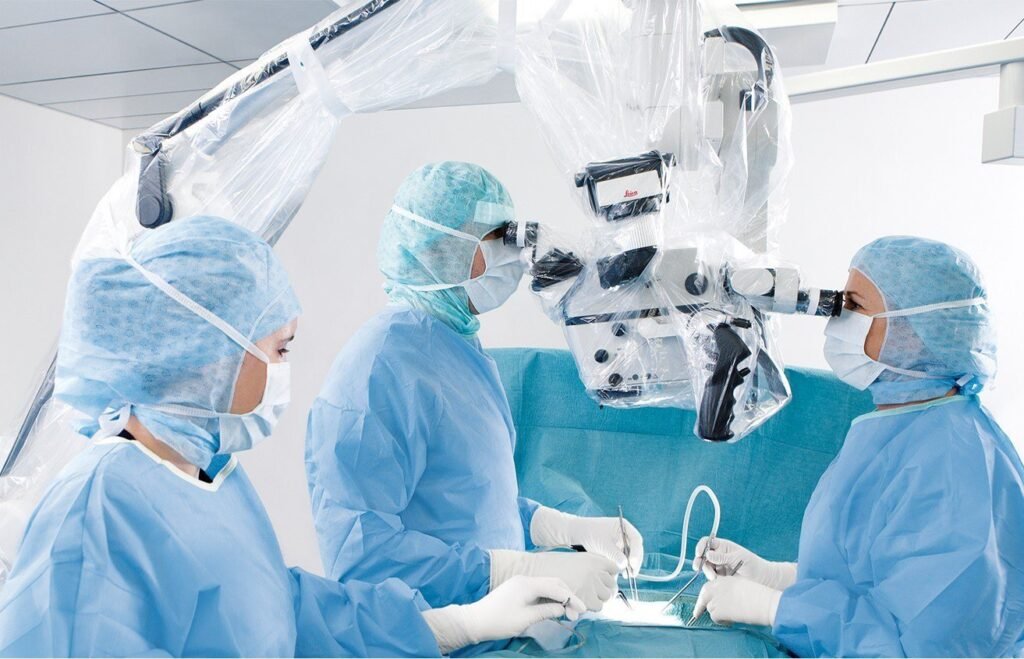
Types of Surgical Microscopes by Specialty
1. Neurosurgery and Spine Microscopes
These are the largest and most advanced. They need long reach, deep focus and strong light for work in narrow, deep spaces.
- Common features: Long working distance, motorized zoom and focus, fluorescence modes, built-in cameras, and side eyepieces for an assistant
- Examples: Leica ARveo and M530, Zeiss Kinevo and Pentero
- Drape: A long drape with three or four ocular covers
2. ENT (Ear, Nose and Throat) Microscopes
ENT surgeons need a fine view of small structures, like the middle ear.
- Common features: Compact head, shorter working distance, good maneuverability
- Examples: Leica M320 and M525 F series
- Drape: Usually a shorter drape
3. Ophthalmic (Eye) Microscopes
Built for cataract, retina and corneal surgery.
- Common features: Foot pedal control of focus and zoom, special lighting that creates a red reflex in the eye, and coaxial light
- Drape: Specialist ophthalmic drapes
4. Dental Microscopes
Used for root canals and other fine dental work.
- Common features: Small, light, often mounted on the wall or ceiling of the treatment room
5. Plastic and Reconstructive Microscopes
Used for joining tiny blood vessels and nerves (microsurgery).
- Common features: High magnification, very steady positioning, and two-surgeon viewing

Types of Surgical Microscopes by Mount
| Mount type | How it works | Best for |
|---|---|---|
| Floor stand | Wheeled base, can move between rooms | Hospitals that share scopes between ORs |
| Ceiling mount | Fixed to the ceiling, frees floor space | Dedicated neuro or spine rooms |
| Wall mount | Arm fixed to the wall | Dental and small procedure rooms |
| Tabletop | Sits on a table or cart | Labs and small clinics |
Floor stands are the most common in US operating rooms because one microscope can serve several rooms.
Which Type Does Your OR Need?
Ask these questions:
- What procedures will you run? Spine and neuro need more reach and features than ENT.
- Will you share it between rooms? Choose a floor stand.
- Do you need video? Teaching hospitals often want built-in cameras.
- What is your budget? See our guide to surgical microscope costs, or consider renting.
Quick tip: Not ready to buy? DB Surgical rents Leica microscopes monthly, including the M320, M520 OH3 and M720 OH5.
Every Type Needs the Right Drape
Each microscope has a different shape, number of eyepieces and arm length. That is why drapes are made model by model.
ASP stocks drapes for:
- Leica: ARveo, M530, M525, M720, M520 and PROvido
- Zeiss: Kinevo, Pentero, Tivato, Vario, Sensera, Movena and Neuro NC4
- Mitaka: MM51 and MM90
Frequently Asked Questions
What is the most common type of surgical microscope?
In hospital ORs, floor-stand microscopes used for neurosurgery, spine and ENT are among the most common.
What is the difference between a surgical microscope and a lab microscope?
A lab microscope looks at slides up close. A surgical microscope gives a 3D view of a live patient from a distance, so the surgeon has room to work with instruments.
Can one microscope be used for several specialties?
Some can. Many hospitals use one floor-stand microscope for spine, neuro and ENT. Optics and accessories may need to change between uses.
Related Guides
About American Surgical Products
American Surgical Products has supplied hospitals and surgery centers across the United States since 2010, with no sales reps and no markups. It is the online store of DB Surgical, a Florida medical device distributor founded in 1997 whose Leica-certified technicians service surgical microscopes across the Southeast. Questions? Call 1 (866) 573-7774 or email service@americansurgicalproducts.com. Se habla español.